Teaching Grain Markets to Think: How AI Supercharges the SPIKE Spot Index
AI can strengthen the SPIKE Spot Index by adding structure, anomaly detection, explanation and scenario analysis around a transparent daily benchmark.
This post is republished from the SPIKE Spot Index website.
Read the original article: https://spike.1d3x.com/en/blog/teaching-grain-markets-to-think-ai-supercharges-spike-spot-index
Ukraine’s physical grain market moves through many small signals every day.
Bids, offers, private deals, port demand, freight costs, farmer selling activity, quality parameters, currency movement and logistics updates all influence the final price level. Some signals are visible. Many are fragmented. Some are shared through chats, calls and private conversations before they appear in any structured data product.
In such an environment, market participants need more than isolated quotes. They need a reliable reference point.
This is the role of the SPIKE Spot Index.
The index helps organize daily spot market information into a consistent benchmark for Ukrainian grain and oilseed markets. It does not replace negotiation. It does not replace trader judgment. It does not tell users what to buy or sell.
It gives the market a clearer daily reference.
The next step is to make this reference more intelligent.
Why local grain markets need better structure
Local grain markets are naturally noisy.
A single bid may reflect a real buyer. Or it may reflect a temporary logistics constraint. A high offer may be a serious signal. Or it may be disconnected from tradeable market levels. A port basis may move because of export demand, freight pressure, vessel line-up changes or currency movement.
During periods of geopolitical stress, this complexity becomes even more important. War, infrastructure risk, export restrictions, border disruptions and changes in logistics routes can quickly affect local price formation.
When market data is fragmented, the cost of wrong decisions rises.
Farmers may sell too early or too late.
Traders may price deals with too much risk.
Exporters may misread local availability.
Banks, insurers and investors may struggle to understand real market exposure.
A local spot index reduces this uncertainty by giving all participants a common market reference.
AI can strengthen this function.
Where AI fits into the SPIKE ecosystem
Artificial intelligence is not a replacement for market methodology.
It is an additional analytical layer.
The foundation remains structured market data, transparent rules and disciplined index calculation. AI becomes useful when it helps clean, interpret and explain the information around the index.
In practice, AI can support the SPIKE ecosystem in several ways.
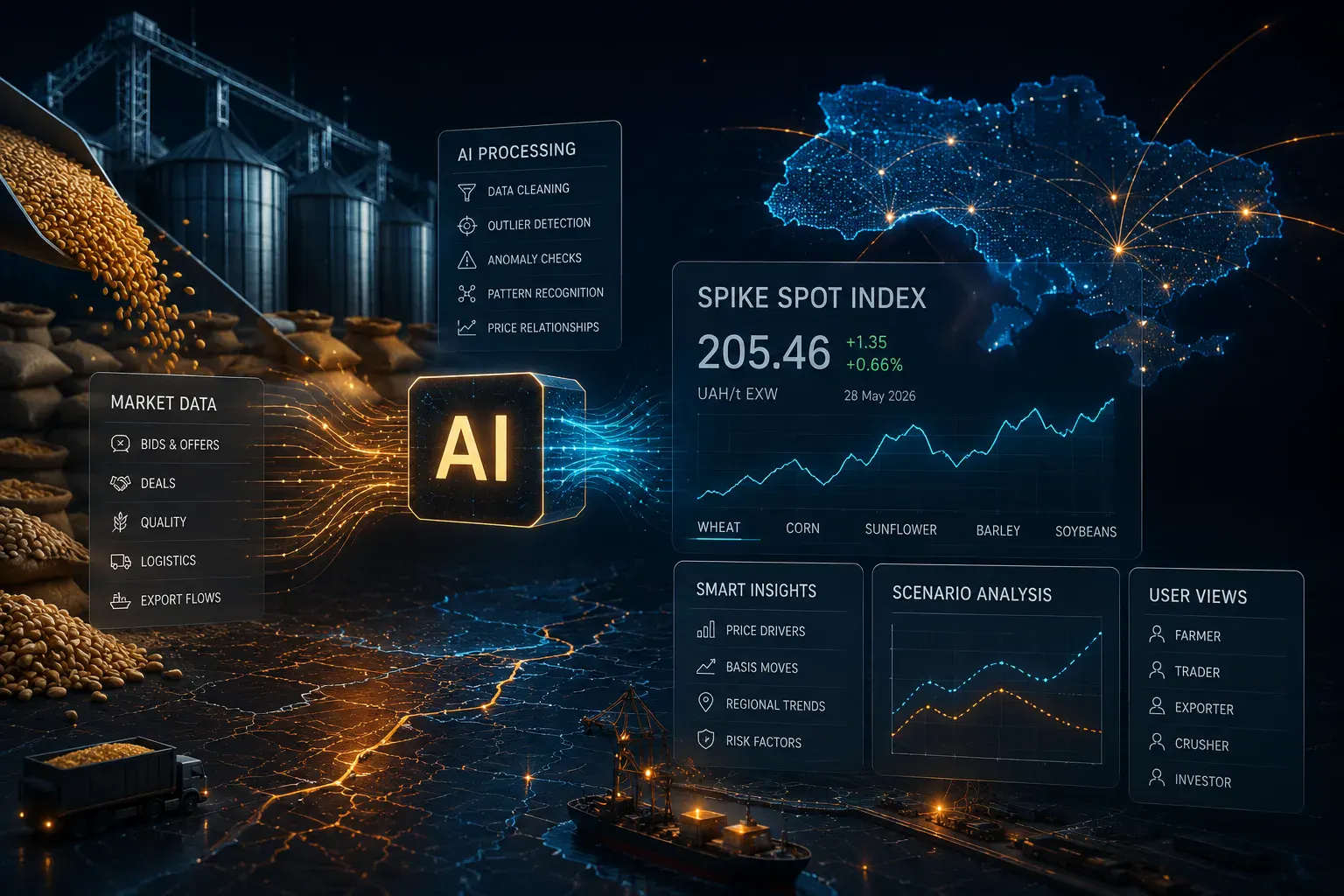
First, it can help clean and normalize incoming bid, offer and trade data. Grain market data often comes in different formats, currencies, units, delivery bases and quality specifications. AI tools can assist in detecting obvious inconsistencies, missing fields or format errors before the data is used in analytics.
Second, machine learning models can learn typical relationships between commodities, regions, delivery bases and ports. If a submitted price is far outside the normal relationship for that commodity and basis, the system can flag it for review.
Third, AI can help explain daily movement. Instead of only showing that the index moved, an AI layer can summarize what changed, where the strongest movement appeared and which market factors may deserve attention.
Fourth, AI can support scenario analysis. Users may ask how local prices could react if freight costs change, export logistics tighten, global futures move sharply or regional supply becomes more active.
In this sense, AI does not make the index less transparent.
Used correctly, it can make the index easier to read.
From raw prices to smarter signals
A spot index begins with market information.
AI can help turn this information into better operational signals.
For example, an automated quality-control layer can detect suspicious submissions: wrong decimal placement, unrealistic freight assumptions, incorrect currency, mismatched delivery basis or volumes outside normal commercial logic.
A dashboard can use AI to summarize daily movement:
What changed today?
Which commodities moved most?
Which regions showed unusual behavior?
Where did basis movement differ from global futures?
What risks should traders and producers watch tomorrow?
A farmer may need a simple negotiation reference.
An exporter may need a basis and risk view.
A crusher may need a local supply and procurement view.
A bank or insurer may need a market-risk summary.
All of these users can work from the same SPIKE benchmark, while receiving a different analytical layer around it.
This is where AI becomes especially valuable.
It can personalize interpretation without changing the underlying market reference.
Benefits for market participants
For farmers, an AI-enhanced spot index can provide a clearer independent reference when negotiating with buyers. Instead of relying only on the first offer, the farmer can compare local price levels with a structured benchmark and understand whether the offer is close to the current market.
For traders and exporters, AI can help reduce pricing risk. If the system highlights abnormal basis movement, unusual regional divergence or suspicious submitted data, commercial teams can react faster and with better context.
For processors and crushers, the index can support procurement planning by showing local price movement more consistently across relevant regions and commodities.
For banks, insurers and investors, a transparent benchmark creates a better foundation for understanding price risk in the Ukrainian agricultural sector.
The most important benefit is not prediction.
It is discipline.
A market with a shared benchmark has a better way to discuss price.
A market with AI-supported analytics has a better way to understand why the benchmark is moving.
The limits of AI in grain pricing
AI is useful only if the data foundation is strong.
If input data is incomplete, biased or poorly governed, the model can produce confident but weak conclusions. A polished AI explanation does not make bad data reliable.
There is also a risk of over-reliance on black-box forecasts.
Grain markets are driven by fundamentals, logistics, policy, weather, farmer behavior, global futures and local commercial flow. AI can help identify patterns, but it should not replace market understanding.
This is why governance matters.
A strong index needs transparent methodology, clear data rules and disciplined review processes. AI should support this structure, not replace it.
The SPIKE approach is based on the idea that market data should be organized consistently before it is interpreted.
AI works best when it is built on top of that discipline.
Toward smarter benchmarks
The future of grain market analytics will not be only about collecting more data.
It will be about turning fragmented data into structured signals.
A robust local spot index gives the market a shared reference point.
AI can add a second layer: cleaning, anomaly detection, explanation, scenario modeling and user-specific insights.
Together, these tools can help reduce information asymmetry in Ukrainian grain markets.
The goal is not to replace farmers, traders or analysts.
The goal is to give them better signals for everyday decisions.
A smarter benchmark does not remove human judgment.
It makes judgment better informed.
For a market as dynamic and strategically important as Ukraine’s grain sector, this is becoming increasingly necessary.