Spot Market Handbook: a practical guide to Ukrainian agricultural price formation
A practical free handbook on how Ukrainian agricultural prices are formed and why spot indices are needed for readable, transparent physical market trading.
At 1D3X, we believe that market indices are not just numbers on a screen.
A good index is market infrastructure.
It helps fragmented markets become more readable, comparable and usable for trading, analytics, contracts, risk management and future data products.
That is why we are pleased to recommend a new free publication released within the Spike Spot Index project:
Spot Market Handbook: How Ukrainian Agricultural Prices Actually Work
The book is currently available in Ukrainian on the Spike Spot Index website.
Why this handbook matters
Ukrainian agricultural prices are not formed in a single place.
They are shaped by physical logistics, FOB and CPT bases, port access, Danube and Black Sea routes, local liquidity, currency movements, respondent data, execution risk and the constant difference between global futures and local physical reality.
This is exactly why spot indices matter.
They do not remove risk.They make risk visible.They help the market understand whether a price movement reflects a real market signal, a temporary logistics distortion, a thin-market condition or simply noise.
What the book explains
The handbook is written as a practical guide for market participants who want to understand how Ukrainian agricultural prices actually work in the physical market.
- why the local physical market is not the same as Chicago futures;
- how FOB, CPT, farmgate and processing bases differ;
- why “one commodity” can have many valid prices;
- how spot markets work in practice;
- what separates an indicative quote, a bid, an offer and an executed trade;
- why fragmented OTC markets need public benchmarks;
- how respondent-based indices are built;
- why median-based calculation is more robust than a simple arithmetic average;
- how outlier filtering protects benchmarks from distorted quotes;
- why insufficient data can itself be meaningful market information;
- how basis risk appears;
- how spot indices can evolve into analytics, APIs and market infrastructure.
The book also includes practical case studies, including situations where Chicago rises while FOB Black Sea weakens, port restrictions widen basis, Danube and Greater Odesa routes create different economics, and a benchmark chooses not to publish when the market is too thin.
Why 1D3X recommends it
1D3X is being developed as an index engine and infrastructure layer for methodology-driven market benchmarks.
Spike Spot Index is one of the projects built around this logic: a practical spot index and analytics product focused on Ukrainian export and processing bases.
For Ukrainian-speaking traders, brokers, exporters, processors, analysts and agricultural companies, this handbook is a useful starting point for understanding why structured market data matters.
It also explains the broader idea behind index-based commodity trading: before a market can become programmable, connected or tokenized, it first needs a reliable reference layer. That reference layer starts with transparent indices.
Ukrainian note
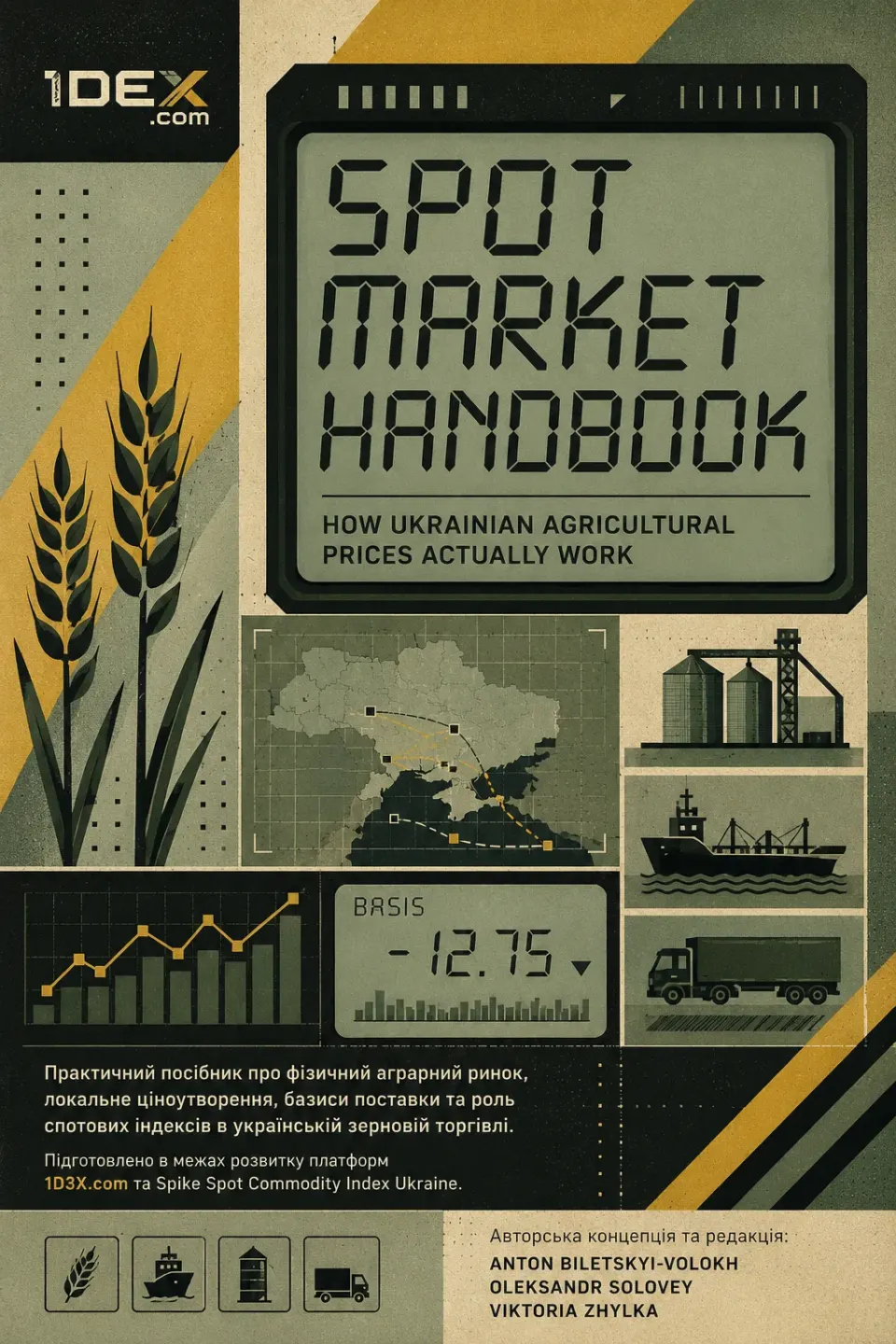
Книга Spot Market Handbook: How Ukrainian Agricultural Prices Actually Work вже доступна українською мовою на сайті Spike Spot Index.Ми рекомендуємо її трейдерам, брокерам, експортерам, переробникам, агровиробникам, аналітикам та всім україномовним учасникам ринку, які хочуть краще зрозуміти, як насправді формуються ціни на фізичному аграрному ринку України.Це не академічний підручник.Це практичний гід про локальні базиси, FOB/CPT, ліквідність, респондентські моделі, спотові індекси, basis risk та майбутню роль індексної інфраструктури в аграрній торгівлі.
English edition coming soon
The current version is published in Ukrainian because the first audience for this handbook is the Ukrainian agricultural market itself.
An English-language edition is planned next.
It will make the same ideas accessible to international market participants, commodity analysts, data infrastructure teams, investors and companies interested in Ukrainian agricultural benchmarks and index-based commodity trading.
For now, we strongly recommend the Ukrainian edition to everyone working directly with the Ukrainian physical grain and oilseed market.
Read it, download it, share it with your team, and use it as a practical introduction to how spot indices can make commodity markets more structured, transparent and readable.